
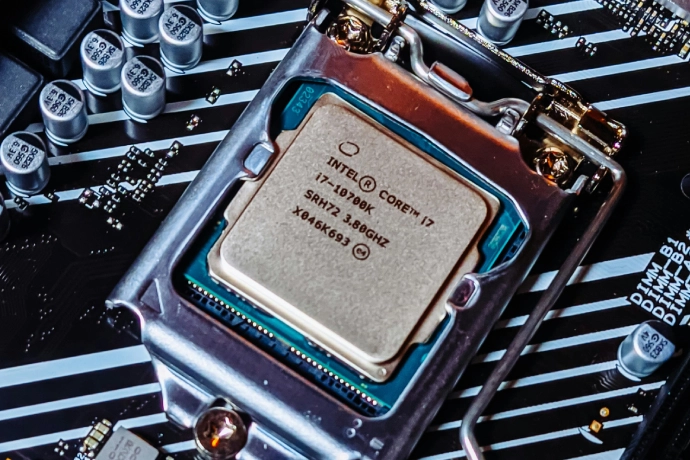
Intel processors often feature various letters and numbers; however, product pages rarely explain their meanings clearly, beyond terms like “unlocked” or similar descriptors. It is common to encounter indicators such as “K,” “F,” combinations of the two, or even other letters like “H” and “V.” Each has a technical justification, and, in most cases, it is quite easy to remember what they represent.
When you see a “K” on an Intel processor, it means the chip supports overclocking (increasing the clock frequency). This allows the processor to operate beyond its official performance specifications, extracting more power from the chip. Gaming enthusiasts and power users—those who enjoy pushing their hardware to the limit—often overclock their Intel-based systems to gain a few extra frames per second in games or to improve their scores in performance benchmarks. While these models are typically the most expensive, they are also the most versatile, making them a suitable choice for a wide range of users.
Furthermore, they offer an advantage over “F” or “KF” variants: they include integrated graphics. This means that if your dedicated graphics card fails, if you haven’t received it yet while building your PC, or if you simply don’t need one, you can use the HDMI port on the motherboard to output a video signal via the processor. Conversely, models with an “F” designation are generally positioned a tier lower and lack integrated graphics; as a result, they are an ideal choice for budget-conscious builds. A prime example is the 12400F model (released in 2022), which, at the time, served as an excellent mid-range option for gaming.
From the KF series to the V series: Intel processor suffixes aren’t that complicated
As you may have already noticed, “KF” is a combination of two categories. These processors are fully unlocked for overclocking and offer performance on par with their “K” series counterparts, though they lack integrated graphics. This option can also save you some money, as these chips are priced somewhere between the other two variants. Occasionally, Intel releases processors that deliver stronger performance at a very competitive price point; a recent example is the Intel Core 7 270K Plus, which provides an extra boost—especially for gaming—and even outperforms what was previously the flagship model, the Ultra 9 285K.
Meanwhile, the “V” suffix appears on all chips based on Intel’s Lunar Lake architecture—the Core Ultra 200V series—which can be found, for example, in the LattePanda Mu Ultra, a device that competes with the Raspberry Pi. As one might expect for 2026, these chips are geared toward professional environments looking to integrate artificial intelligence into their workflows.
Intel processors can feel like a jumble of letters
There are also the letters “S” and “T,” which stand for “Special” and what Intel calls “power-optimized lifestyle,” respectively. But what do the other letters mean? They all have a specific purpose; in fact, once you look beyond desktop computers, the naming convention becomes so complex that it starts to resemble an algebra problem.
In the mobile device segment, the designations “HX” and “HK” follow a logic similar to that of desktop processors: they represent the highest-performance models, with the added feature that they are also unlocked. The “H” indicates that the CPU is not unlocked, while “P” is used for “thin and light” laptops. The letters “U” and “Y” denote devices with high energy efficiency. If you come across a label ranging from “G1” to “G7,” it refers to the graphics capability of the chip itself (usually appearing as a prefix). Meanwhile, the letter “N” is generally reserved for low-power chips found in budget-friendly mini PCs or entry-level laptops, such as the N150 model.
Intel also develops solutions for the embedded systems sector, offering chips specialized for this purpose. It is unlikely you will encounter one of these unless you work in the industry and use them regularly. The “E” indicates an embedded chip, “UE” signifies energy efficiency, and “HE” denotes high performance. The designations “UL” and “HL” refer to low-power and high-performance versions, respectively, in an “LGA” format (designed to be mounted onto a standard motherboard). Other specialized chips include the “X” or “XE” series—geared toward the high-end market—and the letter “B,” which refers to “Ball Grid Array” technology (another method for mounting chips onto a board).